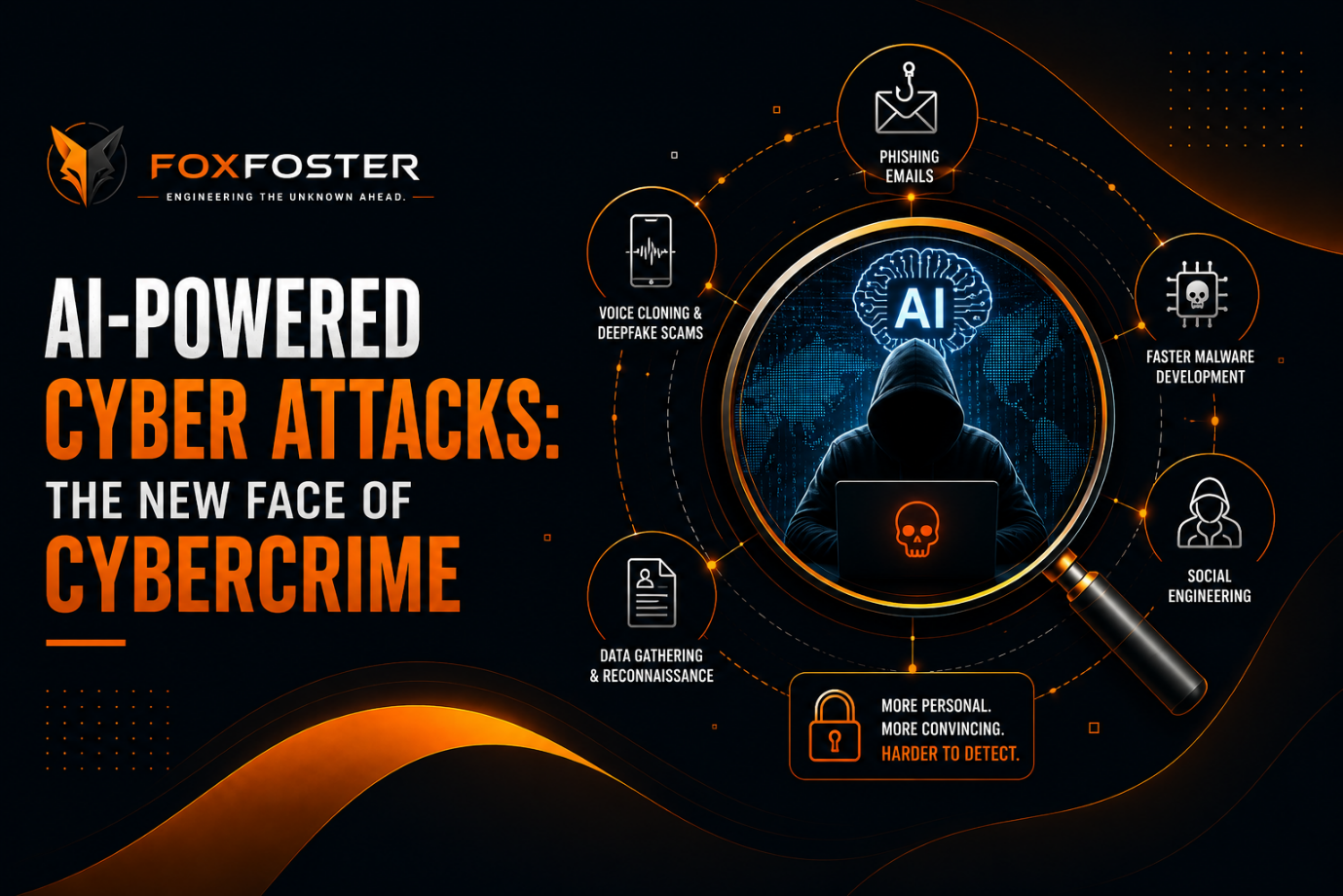
What if a human didn't even write the next phishing email you get?
A few years ago, catching on to a scam online wasn't rocket science. Most of us could catch a fake email pretty quickly and easily just by looking for terrible grammar, differently spaced paragraphs, or a suspicious email address that claimed to be your bank but ended in a random Yahoo domain. It didn't take much to think twice before clicking. But things have changed completely.
Artificial Intelligence has totally flipped the entire story around, like turning the tables upside down. Today, hackers or cybercriminals are using AI to write perfect emails, clone people's voices and even faces, create super realistic deepfake videos, and dig up background info on targets in just a couple of minutes. Attacks that used to take days of manual research can now happen almost instantly.
We all use AI for school or work, whether it's summarizing a long research paper, drafting a quick email, or messing around with image generators. It's an awesome tool for saving time, but the bad guys are realizing they can use it for the same reasons.
AI isn't really inventing brand-new types of cyberattacks. Instead, it's just making old-school scams way more convincing, incredibly easy to scale up, and much harder to catch. As AI tools become more accessible, it's no longer enough to understand how they help us. We also need to understand how cybercriminals are using them. Knowing how these attacks work is just as important as knowing how to defend against them.
Why AI Is Making Cybercrime Easier
Think back about how much work a cyberattack required a few years ago. If someone even wanted to launch a phishing campaign, they first had to research their target deeply, collect information from social media, write convincing emails, develop malicious code, and make sure everything looked believable and legitimate. It took time, planning, and technical skills.
AI basically removes that bottleneck, which is the most important part.
Now, a criminal can use a code assistant to speed up malware development or use a language model to instantly generate a perfect, professional email all in one click. The biggest shift here is personalization at scale. Instead of crowd-sending the same generic scam email to ten thousand random people, which would easily get caught, hackers can now use AI to generate thousands of unique, tailored messages that match the exact tone and background of each victim without even digging into the background of all people being targeted.
We are already seeing this show up in industry reports. For instance, CrowdStrike's 2026 Global Threat Report pointed out that activity from AI-enabled threat groups jumped by 89% over the past year alone. That tells you exactly how fast attackers are adopting this tech into their daily workflows.
How Are Hackers Actually Using AI?
It's not just about one specific type of attack anymore. Hackers are inserting AI into almost every stage of a breach. Here's a breakdown of what that looks like in the real world:
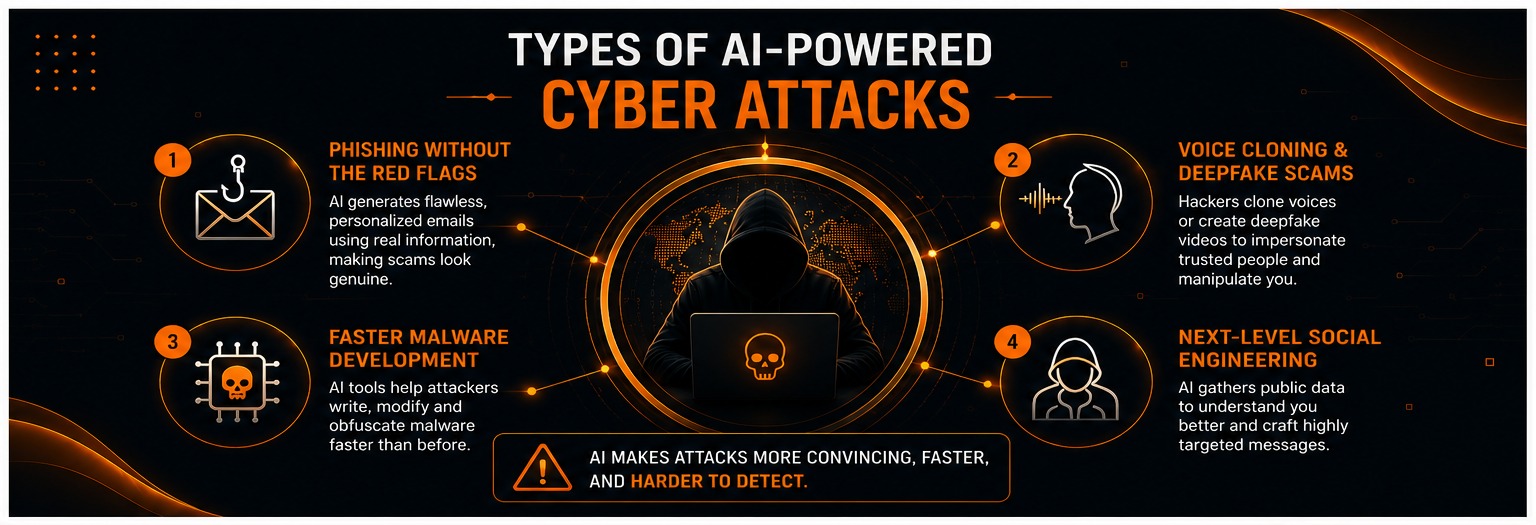
1. Phishing Without the Red Flags
Slips in typos or spelling mistakes that we used to depend on to distinguish a rip-off from a scam and a real person are now nicely masked. AI can generate emails that appear utterly authentic, utilize effective corporate vocabulary and context while extracting genuine information from public platforms such as LinkedIn or other social media sites. Now picture you getting an email that seamlessly mentions one of the projects you have been working on. It sounds all so familiar and perfectly normal, which is why people go and end up falling for it. This type of attack often falls into phishing, and humans naturally tend to believe them.
2. Voice Cloning and Deepfake Scams
This is where it gets terrifying. A modern AI tool can clone your entire voice given only a very short audio snippet from a public video. Cybercriminals are already taking advantage of this to impersonate CEOs, managers, or even a family member. You receive a call from an entity that sounds very much like your boss telling you to wire money right away or to divulge a password. You can't tell it's a scam without verifying through another channel.
3. Faster Malware Development
AI is not going off on its own and making dangerous new viruses, but rather it is a very powerful accelerator for developers. It allows attackers to re-code legacy software even faster, look for bugs in software, or rewrite malware with subtle variations. The standard antivirus programs find it harder to keep up with the amount of new variants appearing on a daily basis because they can produce new variants in a matter of hours.
4. Next-Level Social Engineering
Social engineering is just a politer way of getting people to willingly give you the secrets they are supposed to keep by earnestly establishing trust. AI makes this incredibly easy. An AI can discover who you are in your work life by scanning public profiles and analyzing data across the internet to identify what your job title is, who you work with, and how well your company operates. And when an attacking message is based in that context, your brain instinctively relaxes.
How to Protect Yourself from All These Scams
Because AI is perfecting how an attack may look, we have to rethink our verification process. No more vibe checks.
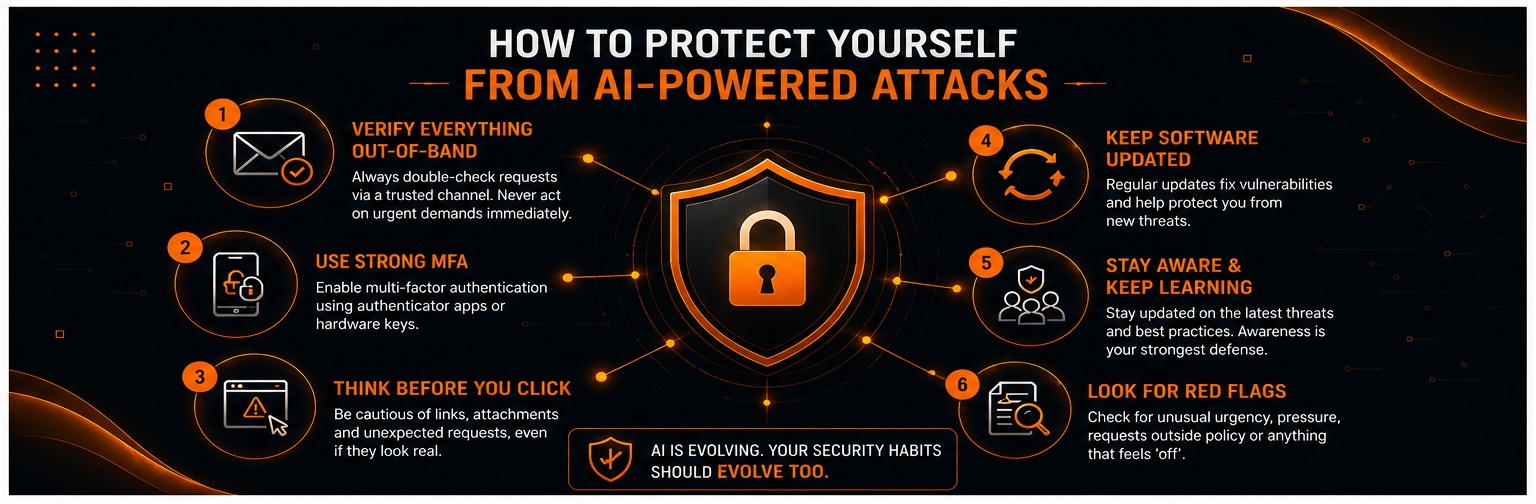
- Check Everything out-of-Band: If you receive a call asking for funds, gift cards, or credentials — even if the voice on the other end sounds exactly like your manager or colleague — never act without verifying. Send them a direct Slack message or return their call to a known personal number to confirm it is really them.
- The Real Trap That AI Can't Hide: AI can fix spelling and grammar, but the underlying scam goal cannot be hidden. Anything that leads to hasty timelines, erratic pressure, or asks you to bypass company policy is a huge potential red flag.
- Introduce Strong Multi-Factor Authentication: As passwords may get captured, make sure to use MFA that cannot be phished — authenticator apps or hardware keys — so that a stolen password alone is not sufficient for access.
Future Outlook: The AI vs. AI Battle
We are moving fast toward a setup where human defenders simply won't be quick enough to stop automated attacks. When an AI bot can find a loophole and launch an exploit in seconds, human security analysts can't sit around manually reviewing logs. Cybersecurity is turning into an autonomous arms race — essentially AI defending networks against malicious AI, where the side with the faster, smarter algorithm wins.
Wrapping Up
AI is a great productivity tool, but for cybercriminals it's the greatest hack of all time. The boundary between communication by humans and content generated by machines has been totally obscured; the old ways we sought out scams simply won't work anymore. Safety is not what you do when you find typos; it is a habit of going through everything before trusting it.
With AI getting this good at impersonating voices, faces, and writing style, are we really going to continue believing video calls or voice notes as real identity?